Resilience
Building Port Resilience against Pandemics
TrainForTrade’s special course, Building Port Resilience Against Pandemics (BPR), has built essential skills for port community managers to help protect people and secure vital trade in ports in a pandemic situation. Its main objectives were to guarantee the health of port workers and users, to keep ports safe and operational during pandemics, and to facilitate the implementation of protocols to ensure health and safety.
Do you want to play the simulation games?
BPR was the first TrainForTrade training where new gamification methods were implemented to develop and renew participants’ e-learning experience. Participants completed two online simulation exercises to consolidate the knowledge they acquired during the course. Exercises tested their decision-making skills in a role-play situation in a pandemic context.
Simulation exercise: Be the captain in this uncertain time!
(15 minutes)
Simulation exercise 2: Are you pandemic-ready?
(15 minutes)
Course Description
Building Port Resilience Against Pandemics (BPR) was an asynchronous/self-paced moderated online course that was delivered over two weeks, and followed by two simulation exercises and a webinar (see agenda below for more details). Port experts engaged with participants online in the forum discussions for each of the course sections.
The online moderated course was structured in four sections, giving a precise and ordered view of the different aspects to be taken into account by a port or port organisation in a pandemic situation. It considered both a general vision and specific actions, the psychological and emotional part related to workers, the technological tools, and also considers actions related to ensuring the main activity of a port in the management of the flow of goods.
At the end of the course delivery, participants were invited to a 90-minute webinar to discuss issues, present best practices, and brainstorm on policy recommendations.
Course manual
- Introduction
- Section 1 – Crisis protocol and communication strategy
- Section 2 – Staff management, well-being, and resilience
- Section 3 – Technology preparedness
- Section 4 – Cargo flow continuity
Course videos
Building resilience in ports
During the first years of this decade, the coronavirus pandemic presented a global threat, leading to severe impacts on entire societies and nations. The maritime industry played an essential role in the response. About 80% of global trade is transported by commercial shipping. This includes most-needed items like vital medical supplies and equipment, as well as food, energy, raw materials, and manufactured goods and components. These are essential for meeting basic human needs, saving many jobs in manufacturing, supporting international trade, and ultimately keeping the global economy afloat. Because of this, world’s ports have to remain accessible for ships during a crisis, and crew changeovers must be permitted. Additionally, some extra measures should be taken to protect port community workers and to ensure port operations can continue in all situations.
UNCTAD Policy Brief on port resilience
Participants of the BPR course in 2021 were invited to suggest recommendations that may be utilized in the future to help draft policy advice related to a pandemic response in port communities. Participants in the three languages provided 300 suggested ideas for policy recommendations. The recommendations were shared on the course page, and participants were invited to vote for those they preferred most. The following policy recommendations were published in February 2022 in UNCTAD Policy Brief No. 93 on Emerging strategies for ports during the pandemic:
- Ports should use business continuity planning processes to develop action protocols for pandemic scenarios based on recommendations from national and regional authorities
- Contingency planning scenarios should be developed for the successful implementation of preventative actions and to identify appropriate responses to suspected infectious cases in a pandemic situation
- A communications strategy that is fit for purpose and aimed at all stakeholders, including employees, suppliers, customers, port users, government agencies and media, is essential
- Port managers should prioritize the education of port workers on how they can best maintain physical and mental wellbeing during a pandemic
- The provision of vaccination facilities, testing centres and contact tracing is a key feature and is needed to support the health and well-being of port workers
- The availability and management of appropriate technology is paramount in a pandemic situation and ports should ensure that technology, capacity and security measures are redesigned to support the high number of staff relying on telecommuting and digital communications for meetings
- Port managers should assign a high level of priority to implementing productivity tools for telecommuting staff and digitalizing processes, to enable business to continue uninterrupted while improving information technology security and resilience
- Designating transport and port workers as essential workers with the particular responsibility of maintaining services can help alleviate disruptions to supply chains, and ports should provide “green lanes” on existing road networks and allocate dedicated berths for vessels in ports for the rapid transport of emergency supplies
Best practices
- Constantly promote and enforce preventive hygiene measures (handwashing)
- Respect physical distancing rules – stay 2 metres apart
- Provide sufficient protective equipment to the staff (face masks, gloves, hand sanitizers, glasses)
- Establish a point of control in the perimeter of the port area to monitor temperature and related symptoms (automated temperature screening) and equip it with anti-bacterial solutions and sanitizers
- Fumigate and disinfect all passenger terminals/areas
- Have a passenger information system for easy contact tracing and an isolated holding and testing area for COVID-19 symptomatic port users
- Identify decontamination areas in the port buildings
- Limit physical interaction between onboard and onshore staff. The ship crew should communicate with the quayside staff by radio or telephone
- Increase the use of digital documentation to limit human contact to a minimum
- Augment the sanitation of surfaces that come in contact with hands
- Establish a waste disposal policy for “suspicious” cases
- Disinfect and monitor cargo
- Institute a protocol for disembarking passengers/crew requiring immediate medical care in coordination with the national health authority (1)
(1) Under the International Labour Organization’s (ILO) Maritime Labour Convention of 2006, flag States must ensure that all seafarers on ships flying their flag are covered by adequate measures for the protection of their health and that they have access to prompt and adequate medical care whilst working onboard. The Convention also requires port States to ensure that seafarers on board ships in their territory who require immediate medical care are given access to medical facilities onshore.
It is crucial to keep the country’s borders open for all forms of freight transport, in particular ports considered to be essential national assets. Governments need to ensure that health measures are implemented in ways that minimize unnecessary interference with international traffic and trade; in particular, by respecting the requirements of “free pratique” for ships under the International Health Regulations (IHR).
The principles of avoiding unnecessary restrictions or delay in port entry for ships, persons and property on board are also embodied in articles I and V and section 6 of the annex of the Convention of the Facilitation of Maritime Traffic (FAL Convention). This is underscored by the International Labor Organisation (ILO) and the International Maritime Organisation (IMO).
The way forward
As ports moved forward to win the battle against this pandemic, several milestones needed to be achieved:
- Boost Internet capabilities and accessibility inside and outside port areas for port workers and users alike. Connectivity, as mentioned by the World Bank Group, is a “public good” after all;
- Increase connectivity and data interoperability in Global Supply Chains by implementing Port Community Systems and taking advantage of Digital Ledger Technology the likes of Blockchain, as promoted by the World Economic Forum;
- Develop shorter and more diversified supply chains supported by advanced automation and labor-protective relocations in line with climate change objectives;
- Reinforce port regional cooperation to build more resilient trade nodes to brace for future COVID-19 pandemic-like shocks;
- Design new policies for resilient and inclusive ports to reach out to the most vulnerable people who are often dependent on the port communities’ economic and social fabric; and
- Engage in innovative training approaches and well-being at all staff levels, leveraging technology.
Crisis Protocol
Here is an example of a crisis protocol that can be used as a guide on actions that should be implemented in relation to strictly defined crisis levels.
SDGs related to this project:

Support:
This project was financed by the United Nations Development Account Tranche 13 (COVID-19) and Irish Aid.
Key Characteristics
| Activities | 2 weeks asynchronous moderated online course, 2 self-paced simulations exercises (30-45 minutes), 1 webinar (90 minutes) |
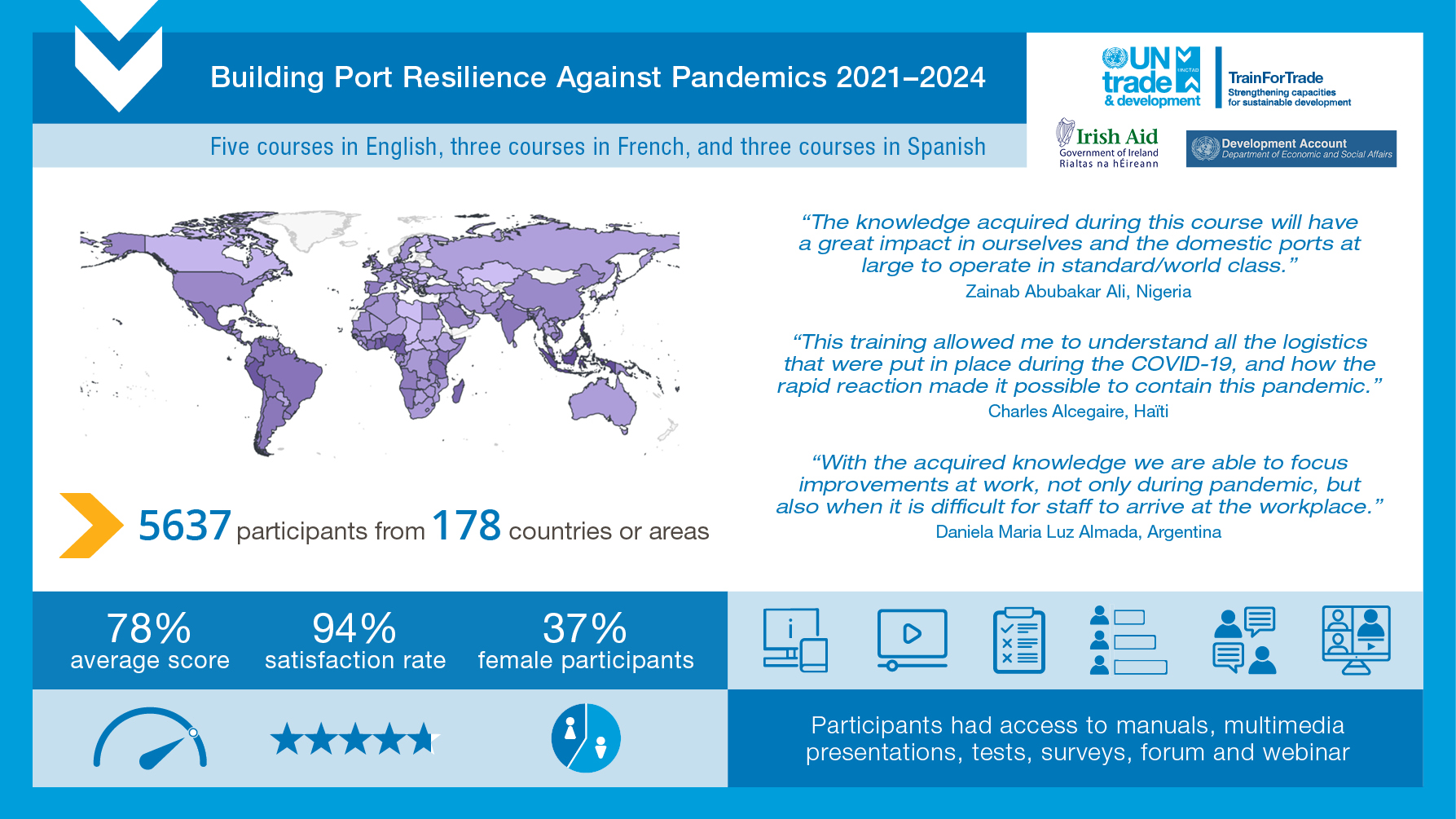
| Number of hours | 20 hours |
| Language | English, French and Spanish |
| Course platform | https://learn.unctad.org/ |
| Completion criteria | Average score from the 2 quizzes (on Sections 1-4) of at least 50% |
| Certificate | Yes – Electronic certificate |
| Price | Free of charge [1] |
[1] This course was financially supported by the United Nations Development Account and Irish Aid with the support of Valencia Port, Spain, and Marseille Fos Port, France.
Target Population
This special course was addressed to all actors involved in international trade, especially those involved with port operations. The course's primary and secondary target populations were representatives from the following organisations:
Primary target:
- Port authorities (those include middle and senior managers)
- Private port management companies
- Port community operators (those include freight forwards, hauliers, customs agents, ship agents)
- Port agents (those include pilots, harbour masters)
- Line ministries staff: Ministry of Transport, Ministry of Health, Ministry of Commerce
Secondary target:
- Trade facilitation committees
- Port security and safety officers
- Labor unions
- Stevedores
- Local authorities
Objective
The objective of UNCTAD TrainForTrade’s Building Port Resilience Against Pandemics (BPR) special course was to support the implementation of measures and to prepare for and alleviate contingencies related to a pandemic in a port, port terminals, and other seaport actors.
More specifically, at the end of the course, participants were able to:
- Describe and prepare crisis protocols
- Prepare communication strategies and implement effective digital communication tools
- Appreciate the potential impacts of pandemics on staff well-being and address any mental and emotional distress-related issues
- Identify appropriate technology solutions for alternative work arrangements
- Assess disruption scenarios for cargoes and passengers
- Identify legal and financial risks
- Define appropriate mitigation measures
Pictures shared by participants during the 2021 course
There were 809 participants registered (36% women) from 96 countries. Over 1200 posts in the fora. 261 policy recommendations shared, 1000+ votes
Webinar video 27 July 2021
Background of the Project
In the times of the global pandemic, various United Nations entities combined their efforts to propose a joint project that will implement standards, guidelines, metrics, tools and methodologies to immediately help governments, including Customs and other border agencies, port authorities, and the business community worldwide, to keep transport networks and borders operational to facilitate the flow of goods and services, while containing the further spread of the COVID-19 virus. One of its components focused on port resilience against invisible threats and on keeping ports safe and operational during pandemics.
TrainForTrade’s project included the exchange of best practices and new safety standards and the design and delivery of a training package to build essential skills for port community managers to help protect people and secure vital trade in ports (TFT Special Course “Building Port Resilience Against Pandemics”).
e-DACUM : Design of the Course Curriculum
The purpose of the phase from the TrainForTrade methodology called Design a Curriculum (DACUM), is to brainstorm on the subject of the new course being designed, i.e. “Port resilience against pandemics”. The goals are to define the objectives and content of job aids to be developed, write training objectives, define target population, and describe what the trainees would be able to do as a result of the training. Furthermore, the DACUM proposes how to design tests for each objective and how to finally sequence the objectives and group them into modules to form a curriculum. The DACUM process for this special course was held virtually for the first time and during three 75-minute sessions via Microsoft Teams and with the use of Padlet platforms.
Support:
This project was financed by the United Nations Development Account Tranche 13 (COVID-19) and Irish Aid.