Global maritime trade is expected to stagnate in 2026 amid disruptions to major shipping routes and chokepoints, as well as wider trade uncertainty, according to UNCTAD’s Review of Maritime Transport 2026. Geopolitical tensions, trade shifts, supply chain changes, shipping disruptions, digitalization, cybersecurity risks and cleaner energy are reshaping maritime transport, creating complex challenges and new opportunities.
Seaborne trade reached 12.3 billion tons in 2025, rising 1.9% versus 3.9% in 2024. UNCTAD forecasts no growth in 2026, then 3.2% growth in 2027. Disruptions across major shipping routes and chokepoints have forced vessels onto longer journeys, extending transit times, increasing fuel costs, driving port congestion and adding to uncertainty. Alternative ports, inland transport networks and logistics arrangements have helped keep trade moving, but at a higher cost.
The report calls for a shift from crisis response to embedded preparedness and adaptability, with “resilience by design and sustainability by default” guiding investment, planning, and operations.
“Resilience by design and sustainability by default set the standard: maritime transport that keeps essential goods moving to every port, from the busiest hub to the most remote island,” says UNCTAD Acting Secretary-General Pedro Manuel Moreno.
Freight rates were volatile in 2025–26. Container spot rates more than doubled from January to August 2026, and crude tanker rates hit route-level records.
Port Performance Scorecard indicates trends in the port industry
Ports face growing congestion as vessel waiting times increase and shipping routes and port call patterns change. At the same time, they need to invest in digital systems, cybersecurity and climate-resilient infrastructure.
Chapter 4 of the report presents the results of TrainForTrade’s Port Performance Scorecard (PPS). This year, more than 70 port entities reported to the PPS, enabling them to benchmark their performance against regional and global peers. Since 2018, the scorecard has emerged as a comprehensive global database on port performance.
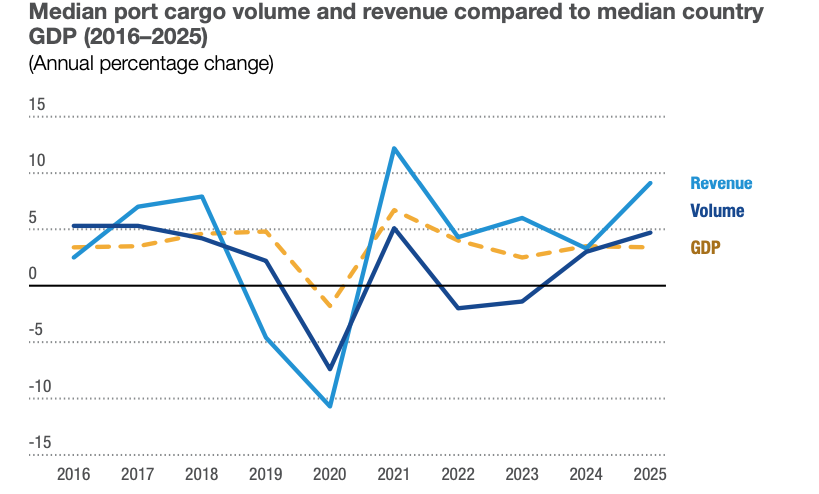
In 2025, port revenue grew by around 9%, compared with 5% for cargo volume. Earnings remained largely within a narrow range of 44% to 50% of revenue. Despite significant global disruptions in recent years, ports maintained stable operational profitability, highlighting their resilience and ability to absorb and respond effectively to successive economic and operational shocks.
Environmental investment rose sharply to 9% in 2025, after remaining below 1% of capital expenditure for most of 2016–2025. This rise signals a stronger focus on sustainability, likely driven by regulatory requirements, stakeholder expectations, and global decarbonization goals.
Women make up 18% of the port workforce, slightly below their 19% peak in 2024. They hold 46% of management and administrative roles, but remain underrepresented in operations and cargo handling.
– Port Performance Scorecard (PPS)