

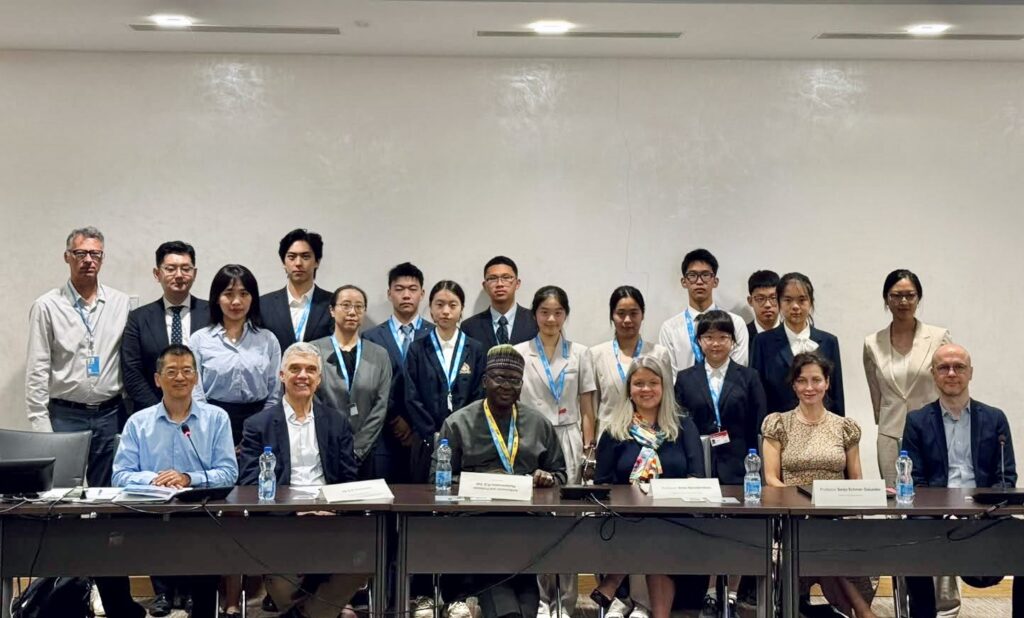
8 July 2026, UNCTAD TrainForTrade welcomed 13 young students, from Chengdu, China, to the UN Headquarters in Geneva for a half-day workshop. The session examined one of the most consequential questions in global trade today: how artificial intelligence is reshaping the multilateral trading system and global governance.
Programme outline
As part of the capacity-building initiatives of the UNCTAD TrainForTrade programme, the session was moderated by Professor Wallace S. Cheng of the Geneva School of Diplomacy, with support from Zheming Xing, Senior Advisor at the Shanghai Green Light-Year Group.
The morning commenced with an engaging opening presentation by Dominique Chantrel, UNCTAD TrainForTrade Programme Officer. Mr. Chantrel introduced the students to the fundamental mission of UNCTAD and the core initiatives of the TrainForTrade programme. This opening briefing sparked interest among the young participants, deepening their understanding of how international organizations operate on the global stage.
The workshop featured keynote insights from Ambassador Professor Muhammadou M.O. Kah, Permanent Representative of the Gambia to Switzerland, who emphasized the necessity of developing countries transitioning from “rule takers” to “rule makers” in global AI frameworks.
In a compelling keynote address, Ambassador Professor Muhammadou M.O. Kah highlighted the urgent need to bridge the widening digital divide as trade governance becomes increasingly tied to artificial intelligence. He stressed that data flows, digital infrastructure, and computing power are rapidly evolving into the de facto trade rules of the 21st century. Expressing concern over a fragmented global landscape, Ambassador Kah warned that without deliberate capacity building, developing nations risk being relegated to passive “rule takers” who inherit frameworks long after they have been drafted. To ensure an equitable global economy, he advocated for extending the principle of Special and Differential Treatment to digital trade and AI governance, calling on international bodies to empower developing countries to actively co-design the standards that will shape their economic futures.
In his closing remarks, Ambassador Kah drew a direct connection between the future of AI governance and the vital mission of UNCTAD’s TrainForTrade initiative.
“We must support TrainForTrade. This is very important because it’s a capacity-building program as well as a governance tool, not just a training exercise. Capacity is a precondition for meaningful participation, for advancing our ability to co-author and co-design rules, and not a side benefit.” — Ambassador Muhammadou M.O. Kah
The session followed by multidisciplinary perspectives from a distinguished panel of experts:
-
Eric Stefanello (Director, Swiss RAISE Foundation; former SVP Airbus)
-
Professor Anna Nesvijevskaia (Professor at University of Applied Sciences and Arts Western Switzerland, Geneva; Head of Intelligence Swiss Initiative [ISI 4C])
-
Professor Sonja Schmer-Galunder (Renwick Leadership Professor in AI and Ethics at the University of Florida)
-
Gregory Shutko (Chief Business Officer at QCentroid)
The programme also included voices from the young participants. Despite their young age, the two student representatives demonstrated remarkable depth and analytical thinking for AI usage through two moving presentations:
-
Zhenhuan Xiang, presented on Cultural Preservation: Using AI to preserve Tibetan cultural heritage, showcasing how technology can safeguard humanity’s shared history.
-
Yilin Miao presented on Ethics & Autonomy: Assessing the risks of over-reliance on AI in everyday decision-making, raising critical questions about cognitive independence in the digital era.
Description
The UNCTAD TrainForTrade programme supports developing countries and the next generation of leaders in navigating the rapidly evolving landscape of global trade and digital governance. By bringing youth into the rooms where global rules are negotiated, the initiative fosters capacity building.
The program bridges the gap between high-level policy and grassroots youth perspectives, ensuring that future framework designs for AI and trade are collaborative, equitable, and sustainable.
The workshop’s main objectives
-
Empower young generation to actively participate in co-authoring global trade and AI governance rules, rather than remaining mere “rule takers.”
-
Invite youth and international students into multilateral decision-making spaces to share innovative solutions and engage directly with global experts.
-
Promote multi-Stakeholder collaboration by bringing together diplomatic, academic, and private-sector experts to address the convergence of AI, ethics, and trade.
-
Support research and dialogue on balancing rapid technological advancement with the preservation of cultural heritage and ethical decision-making.