

Solutions d’apprentissage
Le programme TRAINFORTRADE développe en permanence de nouveaux outils d’apprentissage en explorant de nouvelles possibilités technologiques.
Formation à distance
Le programme TRAINFORTRADE développe en permanence de nouveaux outils d’apprentissage en explorant de nouvelles possibilités technologiques. L’expansion de la couverture 3G/4G, les téléphones cellulaires, les téléphones intelligents et les tablettes, ont rendu l’accès à l’information beaucoup plus facile. Le développement de l’apprentissage “dans les nuages” (cloud learning) et l’apprentissage mobile proposent des solutions efficaces pour le stockage, la diffusion et l’acquisition de l’information et des outils efficaces peuvent être utilisés pour promouvoir l’apprentissage interactif et collaboratif.
Le programme TRAINFORTRADE développe des cours de haute qualité et maintient un standard élevé de diffusion en utilisant des moyens technologiques tels que l’apprentissage en ligne, l’apprentissage mobile et “dans les nuages “(cloud learning). Dans de nombreux pays en développement où les appareils portables sont souvent plus accessibles que les PC, l’apprentissage mobile peut offrir une plus grande accessibilité à la formation en ligne.
Pourquoi la formation à distance ?
La formation à distance permet aux stagiaires ainsi qu’aux formateurs plus de flexibilité dans le processus de formation. L’accès aux connaissances et à l’information se fait dans le temps et à distance utilisant les technologies. L’enseignement à distance permet aux stagiaires de :
- Entreprendre une formation depuis leur domicile ou leur lieu de travail
- Choisir le moment et le lieu d’apprentissage qui conviennent le mieux à leur situation
- Échanger des informations et des idées avec d’autres formateurs et d’autres stagiaires indépendamment de leur localisation
- Bénéficier d’un soutien continu de la part de léquipe TrainForTrade Formation à distance
- Maintenir le contact avec le spécialiste du commerce international et autres institutions de formation.
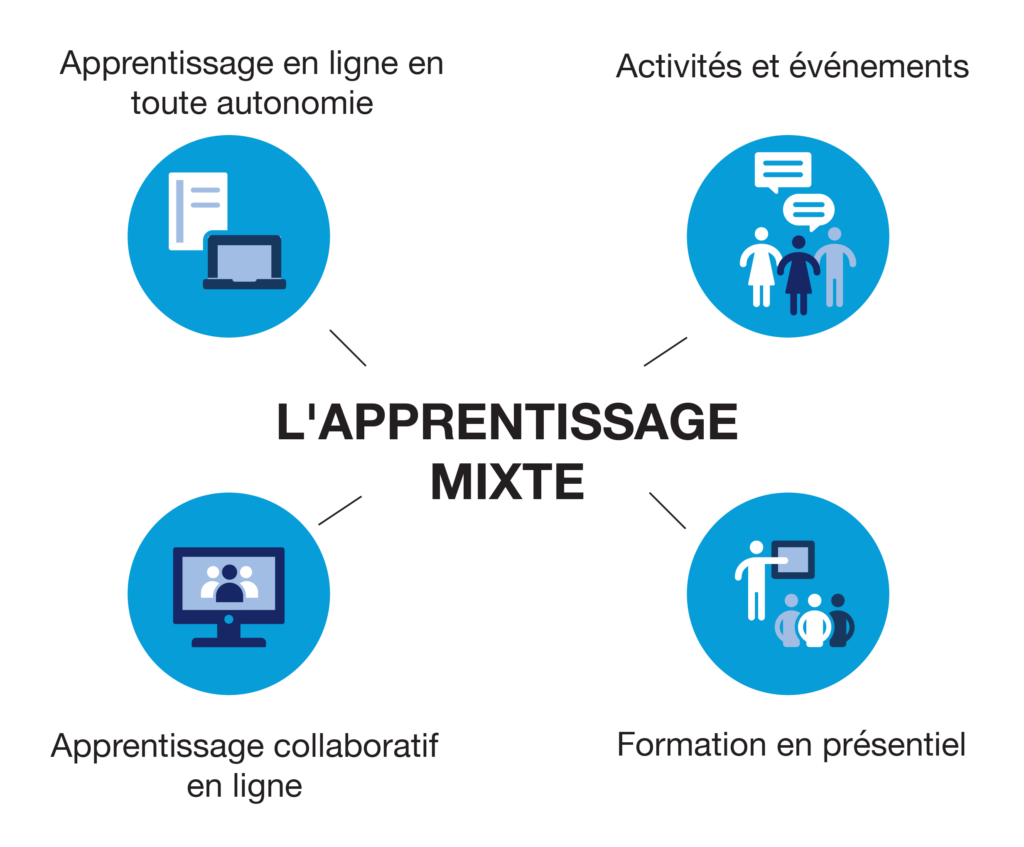
Combiner la formation à distance et la formation en face à face
Le programme TRAINFORTRADE combine les activités en face-à-face avec les cours à distance. L’expérience montre que la qualité des séminaires en face-à-face augmente (en termes de participation des stagiaires et de résultats) lorsque les stagiaires ont d’abord été familiarisés au sujet en question par un cours à distance. Le programme souligne que les aspects pédagogiques de la formation ne doivent pas être compromis par la technologie. Dans un même temps, l’utilisation des TIC comme outil de partage des connaissances augmente le nombre de bénéficiaires tout en réduisant les coûts.
L’expérience montre qu’avec des stagiaires adultes, les résultats d’apprentissage sont meilleurs dans un environnement de groupe que dans le cadre d’un apprentissage à distance uniquement. De ce fait, pendant les cours d’enseignement à distance TRAINFORTRADE, les participants sont réunis dans une même salle entièrement équipée. Les salons de clavardage et les forums sont utilisés pour faciliter les échanges avec les instructeurs.
Dispenser une formation aux futurs tuteurs locaux
Le programme TRAINFORTRADE met l’accent sur l’importance de développer des services locaux, destinés aux populations locales, fournis par des personnes locales. Une étape essentielle du programme TRAINFORTRADE consiste à former des tuteurs locaux qui pourront coordonner sur place les activités de formation à distance. L’identification de centres de formation et de tuteurs est indispensable pour la diffusion d’un cours. Les formations de tuteurs techniques TRAINFORTRADE permettent aux futurs tuteurs de s’approprier la méthodologie TRAINFORTRADE de diffusion d’un cours et les différentes méthodes pédagogiques utilisées lors d’une formation.
Répondre aux besoins des bénéficiaires
The choice of training methods and technology will always depend on the local technical reality in the beneficiary country. The TrainForTrade programme uses Moodle Environment, a Free and Open Source Learning Management System, based on a Linux platform, in order to facilitate
Blended learning methodologies for capacity development
The use of e-learning, either on its own or in a hybrid/mixed model, has not been fully explored by United Nations (UN) Secretariat entities for delivering capacity development activities. TRAINFORTRADE contributed to the report which assesses the current state of e-learning in the economic and social entities of the UN Secretariat and identifies best practices and lessons learned in supporting capacity development through e-learning, or mixed/hybrid methods, and for adapting face-to-face trainings to the online space.

Exemple de formation à distance

Voici un exemple d’un cours en formation à distance
Testimonials
Hybrid Restitution Workshop (Jakarta December 2021)
Leapfrogging skills development in e-commerce in South-East Asia in the Framework of the 2030 Development Agenda
Some excerpts from the Golden Book are presented below:
“The workshop has been inspiring featuring several experienced experts offering some valuable insights. The shared use cases and insights about the digital identity are very relevant to my job in the area related to digital government initiatives.”
“This knowledge will be useful for me to build the similar principle in building systems and data practice within the corporation as well as public sector, e.g. building enterprise data governance as foundation to build enterprise analytics.”
“I loved the session on e-commerce especially since we handle trade and industry and we are currently promoting e-commerce and how MSMEs should go into it.”
“I like the various perspective and shared experience from the participants on the Digital identity and e-commerce. The input and feedbacks given also benefits others in implementing the digital identity framework at their countries.”
“The course really creates beautiful insights in terms of looking into different perspectives of different countries.”
“The collated insights from the use case studies and a series of discussions allowed me to appreciate the value of having well founded policies that induce harmony across the region.”
Blended learning course on International Merchandise Trade Statistics 2021
“This course helped me understand conceptual frameworks, institutional arrangements, compilation and methodology of collecting data, and how to systematically disseminate information,” said Durairaj Kumarasamy from India.
Arina Tinkova from Russia said: “The course helped me understand the processes behind the export and import values that we see in our databases.”
Ines Maria Silva Correia from Curaçao said: “I got detailed information on how to compile trade statistics and the rules to consider, such as privacy and legal issues. It was also interesting to learn how other countries produce good quality figures.”
Cynthia Aryshandy from Indonesia said: “This training provided an excellent platform to better understand IMTS and compare the practices of developing and developed nations. The participation of many countries also facilitated information exchange.”
Serrah Maria Acquita Mulipola from Samoa said: “The course contributed immensely to my knowledge and understanding of trade statistics and the importance of metadata. One challenge that we currently face in our country is limited access to information, particularly trade statistics. However, I now understand that agencies such as the customs office and the central bank always have trade statistics available at any time.”
Blended learning course on Trade in Services Statistics 2019
The following summarizes selected comments from the golden book 2019:
“Valuable experience, very related to my work. Many thanks to everyone who share in this course.”
“It was terrific! I have learned a lot. In a comprehensive point of view the face to face activity was very interesting and useful.”
“The scope of the course is comprehensive and broad, and related to my work areas. All speakers have very deep knowledge on the topics discussed. Participants were actively participating by raising questions and comments. Overall, a very good training experience. We will be further studying about the nowcast methodology and consider its possible uses during our compilations; study on the possibility on disaggregating future data according to the EBOPS classification.”
Blended learning course on International Merchandise Trade Statistics 2018
“The knowledge gained during the online course and the workshop would enable the preparation of better quality data and support to countries.”
“Keep steadfast with these training initiatives that are geared towards Member States to further increase their capacity and dynamic in this regard”.
“The course was very interesting and useful to my job. It also helped me to better understand my job and the different ways in which other countries deal with their trade data”.
Mr. Daniel J. Ndori
“The program is excellent and relevant to the developing nations. The participation of candidates from Maldives, Indonesia and Ghana enabled me to network and create an environment for future South-South interactions. Coming from an IT background, the use of an open-source platform (Moodle) for delivering this course has encouraged me to think and act in advising my CEO in adopting this platform since Tanzania ports has its own institution college (Bandari college) to train port and employees. UNCTAD’s support in conducting this course is very much appreciated and I will put what I have learned in practice.”
Mohamed Hashim
“This a very interesting program. It would be better if you conduct this training for certain region and invite participants of that region. Anyway this program will benefit our country very much from the knowledge we gained. It will be very easy for us to conduct distance learning program in the field of port management or other. We have learned enough to conduct a training program between the remote locations of the Maldives.”